Pesticide Central
Our chemical footprint, and the burden we may carry
Pesticides become invisible once they are sprayed. This page follows them from the companies that make them to the bodies that carry them, and asks at every step who carries more. It begins with the United States, India and Uganda, and with one finding: the less a country measures, the less it can see of the people likely to carry the most.
Interactive maps
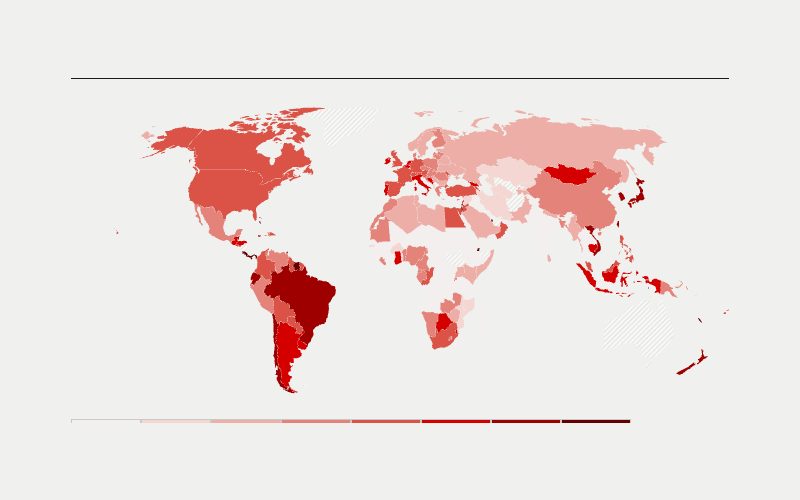 Pesticide use, country by country
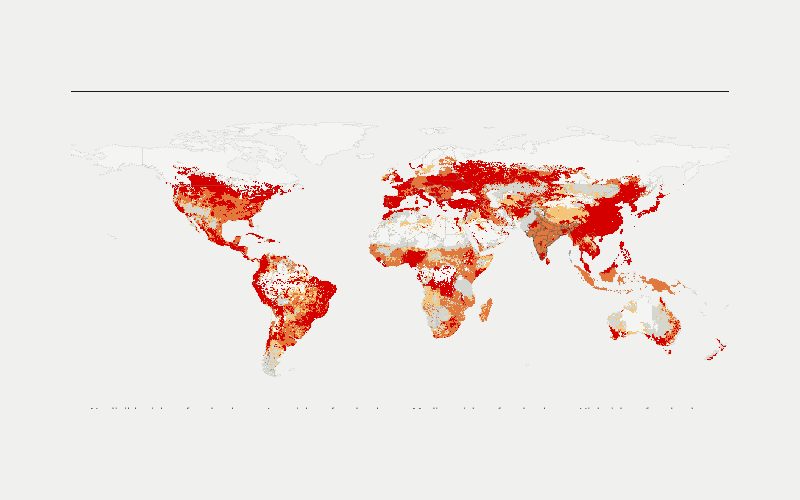 Where farmland is at risk, and who lives there
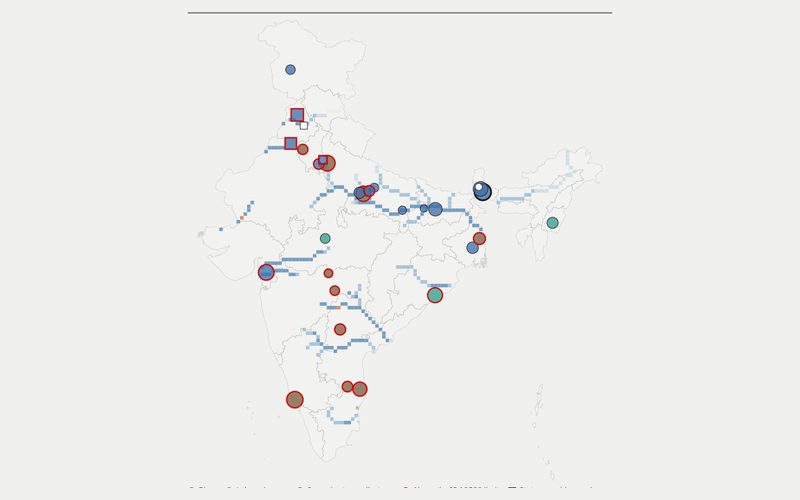 Pesticides in India's waters
What is measured, and where
Each country sees a different part of the burden
| Bodies | Food | Water | Poisoning deaths | |
|---|---|---|---|---|
| United States | National biomonitoring (CDC, NHANES) | National (USDA Pesticide Data Program; FDA) | National (USGS) | Not reviewed here |
| India | No national programme found; site studies only | National residue monitoring | Site studies only | National (NCRB, by method of suicide) |
| Uganda | Site studies only | No national system found; site studies only | None found | Hospital studies only |
In none of the three countries are farmworkers, the people who mix and spray, measured at national scale. Our review as of October 2026; a national programme we missed would change a cell, and we will correct it.
The footprint
How much is used
To picture it
- About 450 grams for every person on Earth, every year: roughly a bag of sugar each.
- About 10,200 tonnes every day, or the weight of the water in some 1,500 Olympic swimming pools each year.
- On a football pitch of cropland (about 0.71 hectares), each year:
Explore every country, 1990 to 2023, on the global map →
See where farmland is at risk of pesticide pollution, and who lives there →
What is known, and not known, about pesticides in India's rivers, lakes and wells →
Uganda's figure has risen from about 0.39 kg in 2020. India's figure is 40,094 tonnes: India last reported it officially for 2010, and FAO has carried the same number forward ever since, flagged as imputed for 2011 to 2021 and estimated for 2022 to 2024. India's own plant protection directorate records a larger number in a different unit: 64,506 tonnes for 2022–23 in its August 2026 tables, and 53,630 tonnes in the version on the government's open data portal. Almost the whole gap between the two official releases is one territory, Jammu and Kashmir, revised from 391 to 11,267 tonnes. The directorate adds technical-grade chemical and formulated product together, so neither figure is active ingredient. The true figure is not known, and the state's own two numbers for the same year differ by a fifth. These are kilograms of active ingredient, the chemical that does the work. The products sold, with their carriers and solvents, weigh more. National averages also hide where spraying concentrates: a low national figure can sit over heavily sprayed districts and crops. Mapping that concentration, with certified farms as islands in a conventional matrix and the people who live and work beside the fields, is the layer we are building next.
The burden
What reaches food and bodies
- United States. Glyphosate was detected in the urine of 81.2 percent of people aged six and over in 2013–14, and levels fell over the following years. Detection shows recent, low-level exposure; on its own it does not show harm.2
- United States. In 2023, USDA tested 9,832 food samples and found more than 99 percent below EPA's tolerances.3
- India. Two ministries report two figures. Agriculture: 3.1 percent of 70,652 fruit and vegetable samples above legal limits over three years (reply to Parliament, August 2026). Health: 2.8 percent of 86,401 food samples, 2022–25 (Rajya Sabha, August 2025). Both draw on the same national monitoring scheme, reported with different sample counts and different numbers of laboratories.4
- India. 25,770 suicides by consuming insecticides were recorded in 2023, 15.0 percent of all suicides, and a further 7,828 accidental deaths from insecticide or pesticide poisoning. The official series does not record the person's occupation alongside the method.5
Bodies that carry
From a mother's milk to a killer whale
Pesticides do not stay where they are sprayed. They move into the bodies of people and animals, and the bodies that carry the most are rarely the ones that were measured first. These are stand-ins: well-documented cases, each read in the original, that show where the burden ends up.
- Mothers and newborns, North India. In 130 samples of colostrum and breast milk, the most common organochlorines were dieldrin, beta-HCH and aldrin, at averages near 1,000 nanograms per gram of milk fat; aldrin and dieldrin have long been banned. Concentrations rose over the months of breastfeeding, and women who ate fish and meat carried about 3.5 times more than women who did not.
- The milk India drinks. Of 1,183 samples of cow and buffalo milk from Bangalore, Bhubaneswar, Guwahati, Ludhiana and Udaipur, between 6.3 and 11.2 percent were contaminated, some above legal limits; for children, the estimated hazard from lindane, DDT and ethion exceeded the safe threshold in Ludhiana and Udaipur.
- Bees, everywhere. Of 198 honey samples from around the world, 75 percent carried at least one neonicotinoid insecticide, and 10 percent carried four or five, below the limits set for people who eat honey but evidence that pollinators feed on them across the globe.
- Vultures, South Asia. The oriental white-backed vulture, once one of the most common raptors of the subcontinent, declined by more than 95 percent from the 1990s at Keoladeo National Park, where the decline was first noticed; residues of diclofenac in the carcasses of treated livestock caused the kidney failure that killed them. Diclofenac is a veterinary drug, not a pesticide, but it is the clearest case in the region of a chemical climbing a food chain until a species nearly vanishes.
- Birds of prey. Among the first signs that organochlorine pesticides were harming wildlife were eggshells: in 1967, the shells of certain birds of prey were found to have become lighter.
- Killer whales. More than 30 years after a near-global ban, PCBs, an industrial chemical, threaten the long-term survival of more than half the world's killer whale populations, through harm to reproduction and immunity.
- Fish on the plate, Brazil. In 18 species of fish and three of bivalves sold in southern Brazil, the DDT breakdown product p,p′-DDE was the residue found most often, with signs of recent dicofol use in one species. Brazil is the largest buyer of India's pesticide exports.
Sources: Dwivedi, Mahdi and Deo 2023, Environmental Research 221: 115216; Gill et al. 2020, Scientific Reports 10: 8054; Mitchell et al. 2017, Science 358: 109–111; Oaks et al. 2004, Nature 427: 630–633; Ratcliffe 1967, Nature 215: 208–210; Desforges et al. 2018, Science 361: 1373–1376; Ferreira et al. 2026, Marine Pollution Bulletin 224: 119117; India's exports: Directorate General of Commercial Intelligence and Statistics, 2025-26.
Beyond pesticides
PFAS and industrial pollutants: the limits India has not written
What PFAS are, in everyday terms. PFAS, often called 'forever chemicals' because many break down very slowly and build up in people, animals and the environment, are the coatings and treatments in non-stick pans (the non-stick tawa and kadai), stain- and water-repellent fabrics, carpets and raincoats, grease-proof food wrappers, pizza boxes and microwave popcorn bags, some shampoos, dental floss and cosmetics, and the foam used to fight fuel fires. Several pesticides are themselves PFAS by structure: one 2026 review tracked 55 PFAS-based pesticides in Indian grapes.
Pesticides are not the only chemicals the water standards treat unequally. The United States now limits PFOA and PFOS, two of the synthetic 'forever chemicals', to 4.0 nanograms per litre each, about four seconds in 7,900 years, and requires quarterly testing wherever they exceed a trigger level; in May 2026 the EPA proposed to keep those limits while letting systems apply for two more years, to 2031. The European Union's limit on the sum of 20 PFAS applies from January 2026. India's drinking-water standard, its bottled-water regulation and the Jal Jeevan Mission's testing framework contain no PFAS parameter at all.
Checked, not assumed. We read each instrument for any PFAS parameter: IS 10500:2012, the food regulator's packaged-water regulation (2.10.8) and its full contaminants regulation (compendium of 3 February 2026), and the Jal Jeevan Mission framework. None names PFAS. The Central Pollution Control Board told the National Green Tribunal on 27 August 2024 that 'there is no standard prescribed for PFAS in drinking water'; the 'first step' it cited was three general ISO methods, none specific to PFAS, while a dedicated test method has been listed as under development at BIS since 2020. Under the Stockholm Convention, India accepts new listings one by one: it has accepted seven, but not PFOS (listed 2009 and 2019), PFOA (2019) or PFHxS (2022). A full paper on this is in preparation.
All values are in micrograms per litre (µg/L), the same unit throughout.
| Pollutant | India, IS 10500 | WHO 2022 | European Union | United States | Who tests it in India |
|---|---|---|---|---|---|
| PFOA, PFOS | No limit | No guideline value | 0.10 for the sum of 20 PFAS; 0.50 for all PFAS | 0.004 each | No one: not in the framework |
| PCBs | 0.5 | No guideline value | Not listed | 0.5 | State laboratories only |
| Polyaromatic hydrocarbons | 0.1 (all PAHs) | 0.7 (benzo[a]pyrene) | 0.10 (four PAHs); 0.010 (benzo[a]pyrene) | 0.2 (benzo[a]pyrene) | State laboratories only |
| Arsenic | 10, relaxed to 50 'in the absence of alternate source' | 10 | 10 | 10 | State and district; block where area-specific |
| Lead | 10 | 10 | 5, from 2036 | Treatment technique; action level 15 | State; district where area-specific |
| Mercury | 1 | 6 (inorganic) | 1 | 2 (inorganic) | State; district where area-specific |
| Cadmium | 3 | 3 | 5 | 5 | State laboratories only |
| Chromium (total) | 50 | 50 | 25, from 2036 | 100 | State; district where area-specific |
| Cyanide | 50 | No guideline value | 50 | 200 | State laboratories only |
For most industrial pollutants, India's numbers match the WHO's. The gaps lie elsewhere. There is no PFAS limit. Arsenic, which the Jal Jeevan Mission names first among the natural contaminants of rural groundwater, is relaxed fivefold for households with no other source, so the people with the fewest options get the weakest protection. PCBs, PAHs, cadmium and cyanide are tested only at state laboratories, far from the villages whose water the limits are meant to protect. And for pharmaceutical waste, the government told Parliament in 2021 that active pharmaceutical ingredients are 'not a notified parameter' for common effluent treatment plants, and that an expert committee had not accepted a standard for antibiotic residues because 'no other country in the world implemented these standards'.
Sources: BIS, IS 10500:2012, Tables 4 and 5; WHO, Guidelines for Drinking-water Quality, fourth edition with first and second addenda (2022), Tables A3.2 and A3.3; Directive (EU) 2020/2184, Annex I Part B and Article 25; US EPA, National Primary Drinking Water Regulations and 40 CFR Part 141 Subpart Z, as in force on 1 September 2026, and the proposed PFOA and PFOS compliance extension of May 2026; Jal Jeevan Mission, Drinking Water Quality Monitoring and Surveillance Framework, pp. 91–92; Lok Sabha Unstarred Question 3585, 20 December 2021.
What the law says it protects
The law's own words
- United States. The federal pesticide law tests for "unreasonable adverse effects on the environment", a standard that weighs costs against benefits.6
- India. The Insecticides Act, 1968 was passed "with a view to prevent risk to human beings or animals". The environment is not named.7
- Across borders. The Rotterdam Convention requires notice and prior informed consent for listed chemicals; it does not stop a country from exporting a pesticide it has banned at home. In 2024, about 122,000 tonnes of pesticides banned in the European Union were notified for export.8
Where the fight stands
As of 15 October 2026
- United States. In Monsanto v. Durnell (25 June 2026, 7–2), the Supreme Court held that federal law preempts a state claim that would require a cancer warning the EPA did not require on the approved label. The Court did not decide whether glyphosate causes cancer.9
- India. In 2013 an expert committee was asked to review 66 insecticides banned or restricted elsewhere. In May 2020 a draft order proposed banning 27; within a month the government amended it to let firms keep making them for export, and in July 2020 a High Court stayed it. The final order of 29 September 2023 cancelled three outright and phased out one formulation of a fourth. Ten years, 66 reviewed, three banned. The Pesticides Management Bill, redrafted in January 2026, has not yet been introduced in Parliament.10
Numbers we do not use
And why
- "385 million unintentional pesticide poisonings a year" is widely quoted. The paper it comes from was retracted in 2024, and no peer-reviewed estimate has replaced it.11
- "Over 60 percent of pesticides in Uganda are fake" is an unattributed ministry statement. What has been measured is narrower: glyphosate bought in Ugandan markets held, on average, 15 percent less active ingredient than its label stated.12
Working papers
Tailwinds
- Permitted Does Not Imply Safe: Why a legal limit is not the same as a safe dose (2026-09)
- Unknown and Undrinkable? India drinks what it does not measure (2026-08)
- Forever, Unlimited: Why India sets no limit for PFAS, the 'forever chemicals' (2026-07)
- Harm Hides Where Measurement Ends: Why no clear evidence is not the same as no harm (2026-06)
- In preparation. India's pesticide ledger: what India makes, uses, exports and imports, from the state's own tables; and limits in context, an interactive guide to what a permissible limit means.
Figures on this page last reviewed 15 October 2026. Each is checked against its source before any update; where a figure was reported rather than read in the primary document, the source says so.
- FAOSTAT, Pesticides Use domain (Pesticides, total), 1990–2023, file released July 2026; most values for India and Uganda are FAO estimates. Licence CC BY 4.0. India's own figure: Directorate of Plant Protection, Quarantine and Storage, consumption 2022–23, as reported.
- Ospina et al. 2022, Environment International; CDC National Health and Nutrition Examination Survey, 2013–14 and later cycles.
- USDA Agricultural Marketing Service, Pesticide Data Program, 2023 Annual Summary.
- Monitoring of Pesticide Residues at National Level, as reported in replies to Parliament; primary replies to be read before next review.
- National Crime Records Bureau, Accidental Deaths and Suicides in India 2023 (table as re-hosted by OpenCity); primary table to be read before next review.
- Federal Insecticide, Fungicide, and Rodenticide Act, 7 U.S.C. §136(bb).
- The Insecticides Act, 1968 (Act 46 of 1968), long title.
- Rotterdam Convention on the Prior Informed Consent Procedure (1998); Public Eye, report of 23 September 2025, on EU export notifications for 2024.
- Monsanto Co. v. Durnell, No. 24-1068 (U.S. 25 June 2026), 609 U.S. 371 (preliminary print), opinion of the Court by Kavanaugh, J.; Jackson, J., dissenting, joined by Gorsuch, J.
- Draft order S.O. 1512(E) (the government's own notices date it 14 May 2020 and 18 May 2020); S.O. 1881(E) of 10 June 2020 (export proviso); Insecticides (Prohibition) Order, 2023, S.O. 4294(E) of 29 September 2023, Gazette of 3 October 2023; National Crime Records Bureau, Accidental Deaths and Suicides in India 2023; Pesticides Management Bill, 2025 (draft for comment, 7 January 2026).
- Boedeker et al. 2020, BMC Public Health, retracted 2024.
- Ashour et al. 2019, Journal of Development Studies 55(6): 1285–1306; Ministry of Agriculture, Animal Industry and Fisheries, web statement of 11 December 2020.