For journalists and editors
Findings you can use, checked at the source
Tailenders Analytics publishes open working papers and data pages on how rules, money and chemicals reach the people at the tail end in India. Every figure is checked against its primary source, every paper has a DOI, and all of it is free to quote and republish under CC BY 4.0, with credit and a link.
Working papers
What each paper found
2026-11 · The fast lane and the long chain
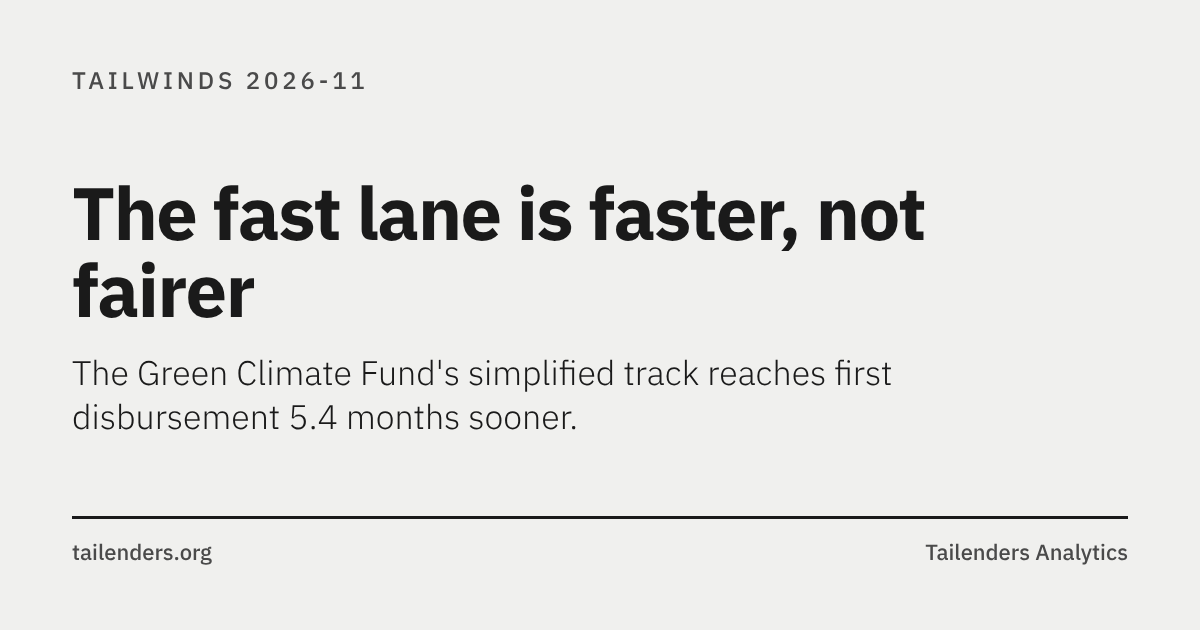
The Green Climate Fund's simplified approval track speeds money to the ground but does not make it fairer. The first test of the Map of Maps of Governance outside India.
- 5.4 months sooner: first disbursement on the simplified track (8.8 months) against regular proposals (14.1 months)
- 372 projects: the Fund's full portfolio, frozen 12 October 2026
- 1.4 months longer: wait of the most vulnerable third of countries against the least, inside the simplified track
Read the paper · PDF · DOI 10.5281/zenodo.24047096 · Download graphic
2026-10 · Counted but Unknown
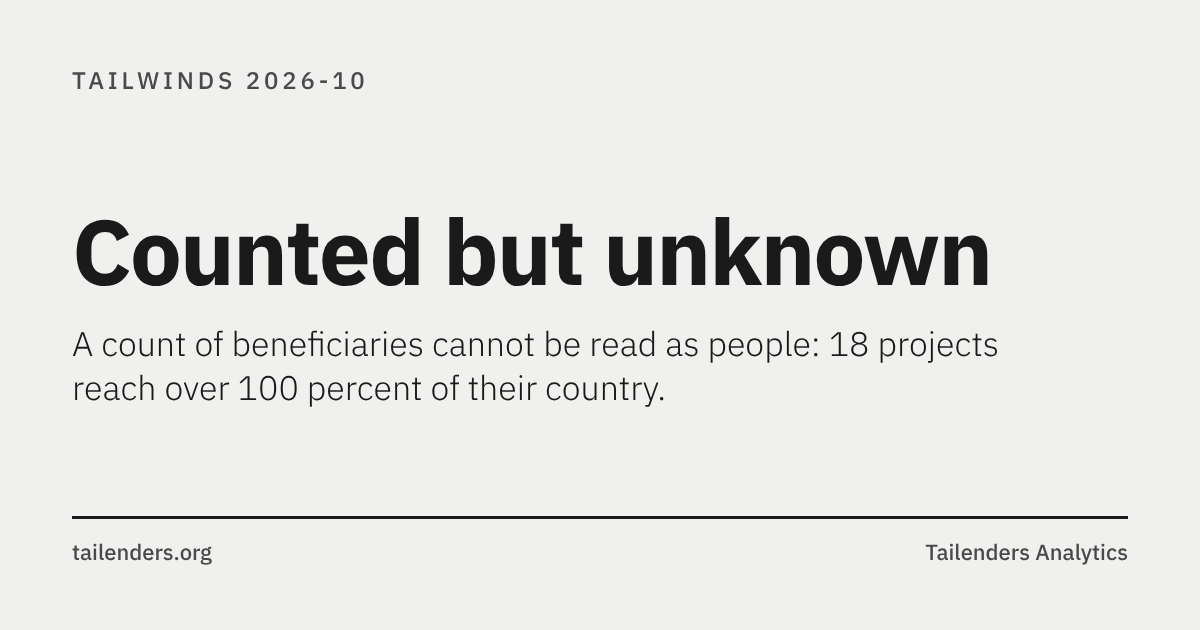
Reaching the most vulnerable countries is not the same as verifying which people benefit from adaptation finance. The Green Climate Fund's record holds a country and a count, and the count cannot be read as people.
- 18 projects: single-country projects that report reaching more than 100 percent of their country, by the Fund's own adaptation indicator
- 372 projects, US$21.31 billion: the Fund's full portfolio, frozen 12 October 2026
- 8.8 against 14.1 months: to first disbursement, simplified track against regular proposals
Read the paper · PDF · DOI 10.5281/zenodo.23826212 · Download graphic
2026-09 · Permitted Does Not Imply Safe
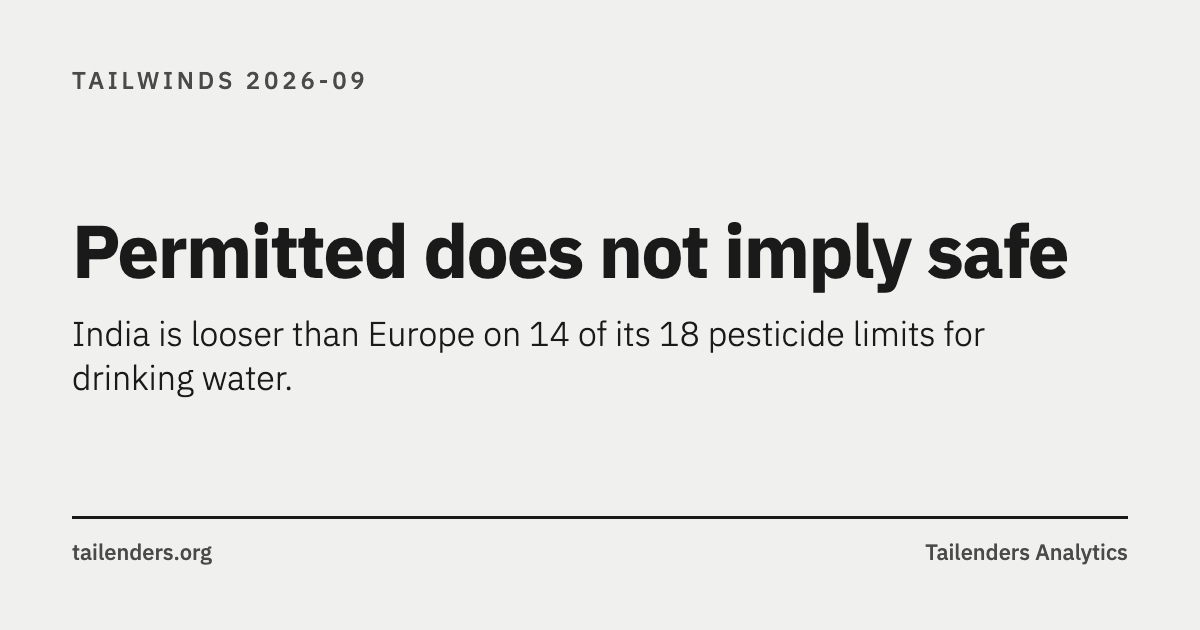
A legal limit is not a safe dose. India's 18 pesticide limits for drinking water, set beside those of the WHO, the European Union and the United States, each read in the original.
- 14 of 18: India's pesticide limits for drinking water that are looser than Europe's
- 1,900 times: India's malathion limit (190 µg/L) against Europe's 0.1 µg/L
- 10 of 18: India's listed pesticides for which the WHO sets no guideline value
Read the paper · PDF · DOI 10.5281/zenodo.23445211 · Download graphic
2026-08 · Unknown and Undrinkable?
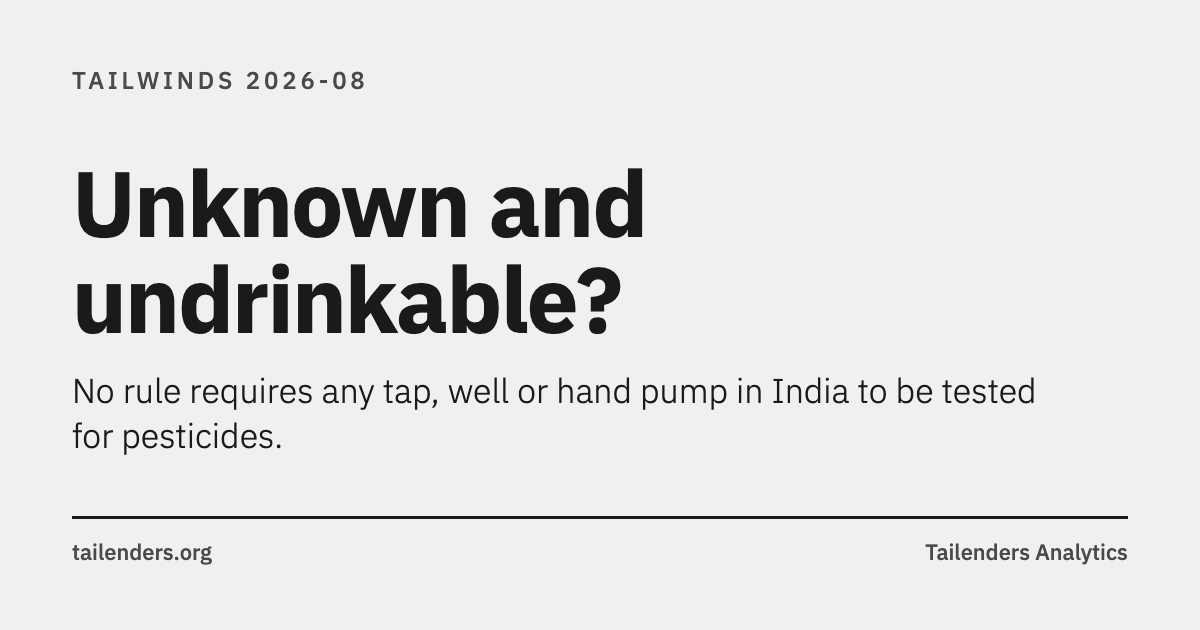
India sets limits for 18 pesticides in drinking water but no testing frequency, and we found no rule requiring any tap, well or hand pump to be tested for pesticides. A clean record is not the same as clean water.
- 114: the most river stations with pesticide data in 2020, one for every 12.3 million people
- Once a year, before the monsoon: the river network's pesticide sampling rule
- About 145 times: India's limit for α-endosulfan, found in Kasaragod wells
Read the paper · PDF · DOI 10.5281/zenodo.23445209 · Download graphic
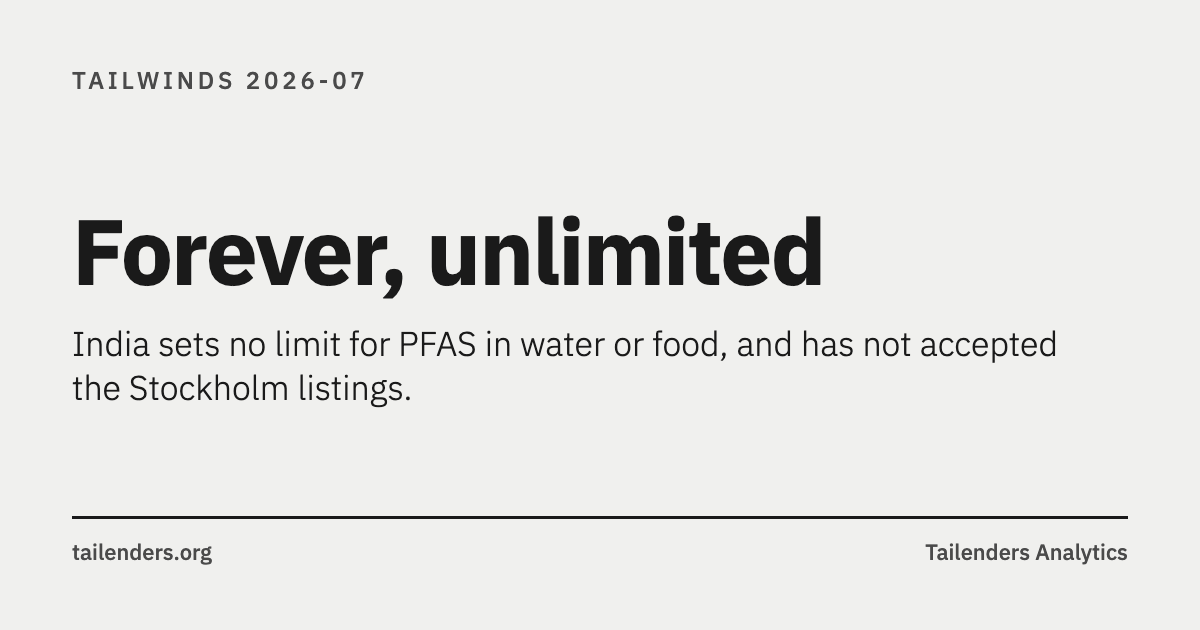
2026-07 · Forever, Unlimited
India sets no limit for PFAS, the 'forever chemicals', in drinking water, bottled water or food. The United States limits PFOA and PFOS to 4 nanograms per litre each; the European Union limits the sum of 20 PFAS. The paper opens in Bhopal, where the law came after the harm.
- No PFAS parameter in IS 10500, the packaged-water and food contaminant regulations, or the Jal Jeevan Mission's testing framework
- 7 Stockholm Convention listings accepted by India; not PFOS, PFOA or PFHxS
- 2,660, about 3,000 and 5,295: three death tolls for the Bhopal gas leak in the Supreme Court's own record
Read the paper · PDF · DOI 10.5281/zenodo.23444989 · Download graphic
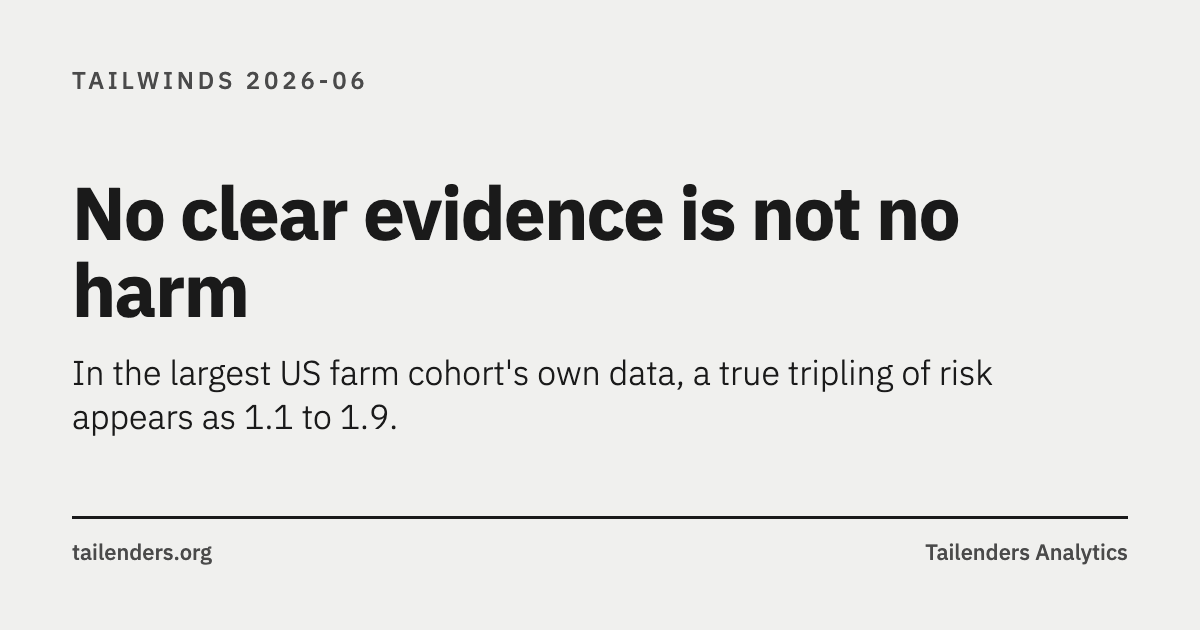
2026-06 · Harm Hides Where Measurement Ends
Most people are certain that pesticides harm us; regulators keep concluding that typical exposures are safe. Both are right about different people: harm is real at the tail of exposure (sprayers, women who mix concentrate, children exposed in the womb), and the evidence system averages that tail away.
- 1.1 to 1.9: how a true tripling of risk appears in the largest US farm cohort's own validation data
- 19,769 fewer suicides in Sri Lanka in the decade after its 1995 to 1998 bans of the most toxic pesticides, with no measurable loss of yield
- None of the United States, India and Uganda measures farmworkers' exposure at national scale
Read the paper · PDF · DOI 10.5281/zenodo.23436116 · Download graphic
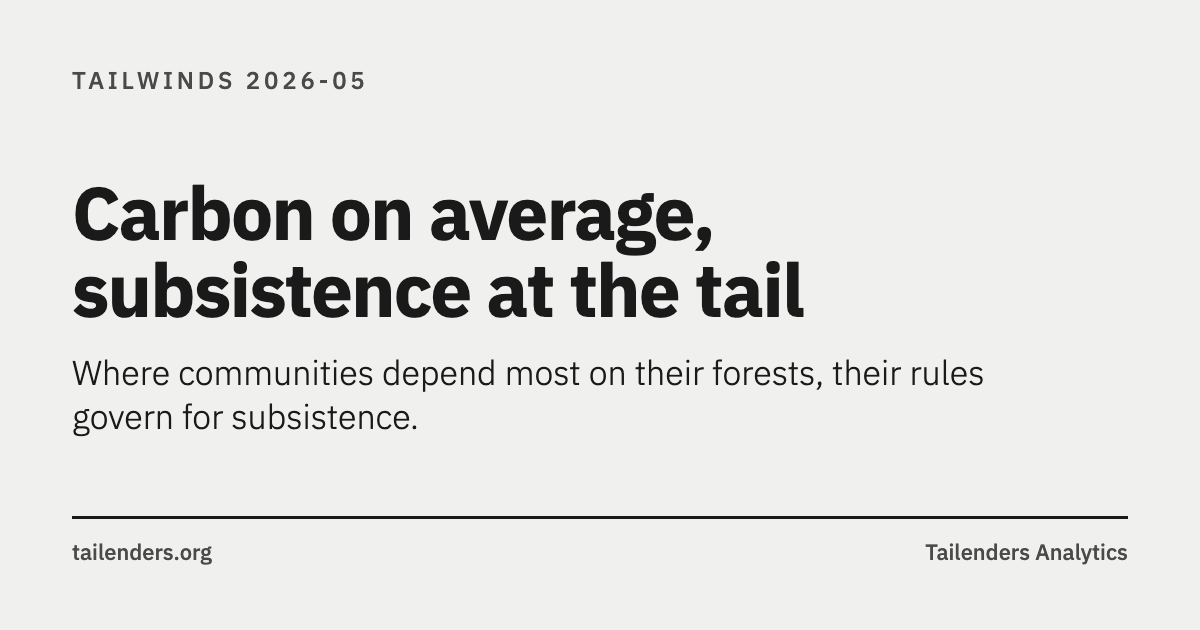
2026-05 · Whose Rules? Which Forest?
Restoration finance is learning to reward communities that make their own forest rules. Across 314 forest commons in 15 tropical countries, rule-making predicts carbon on average; where communities depend most on their forests, it predicts subsistence instead.
- +7.7 points: rule-making's association with the high-carbon cluster across all forests
- −5.9 points: the same association in dependent, low-literacy communities
- 15.8 to 27.0 points: its association with subsistence, from all forests to the tail
Read the paper · PDF · DOI 10.5281/zenodo.23433466 · Download graphic
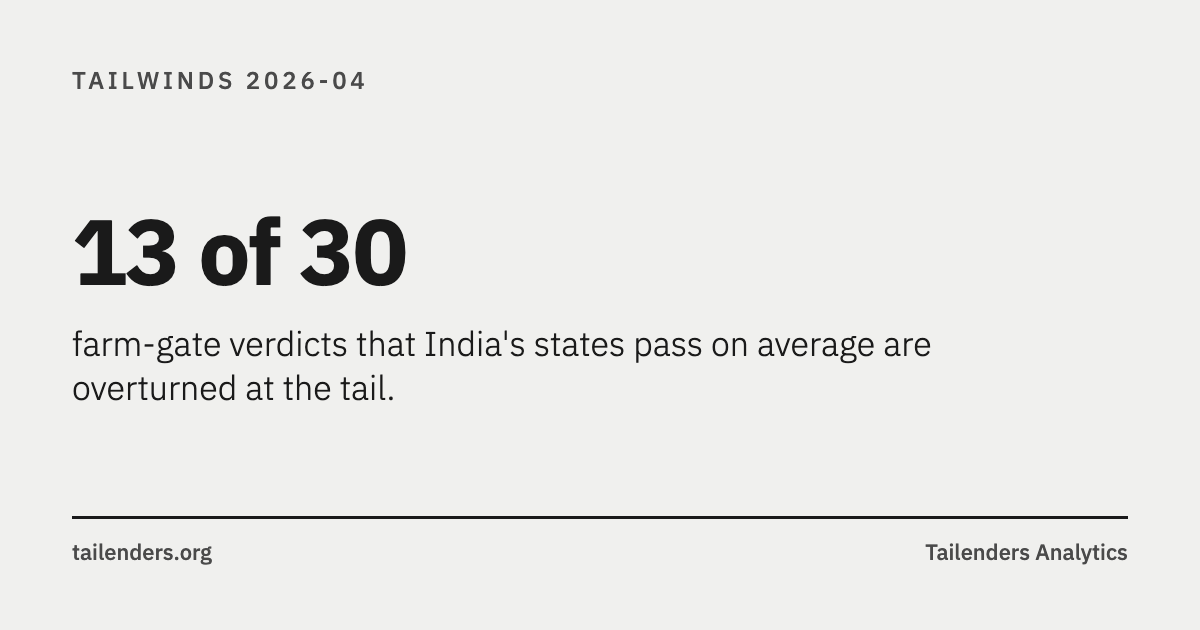
2026-04 · The tail inside the average
India judges farm policy by averages, and averages hide its failures. Using the National Sample Survey of agricultural households (58,040 households, 36 states), the paper walks each state down its tail to the smallest, poorest farms.
- 13 of 30 farm-gate verdicts that India's states pass on average are overturned at the tail
- 228 of 1,017 tests fail, where about 51 would by chance
- 71.5 percent of Chhattisgarh's farm households know the minimum support price; among Scheduled Tribe households on 1 hectare or less, 50 percent do
Read the paper · PDF · DOI 10.5281/zenodo.23307497 · Download graphic
2026-03 · Where, but not who
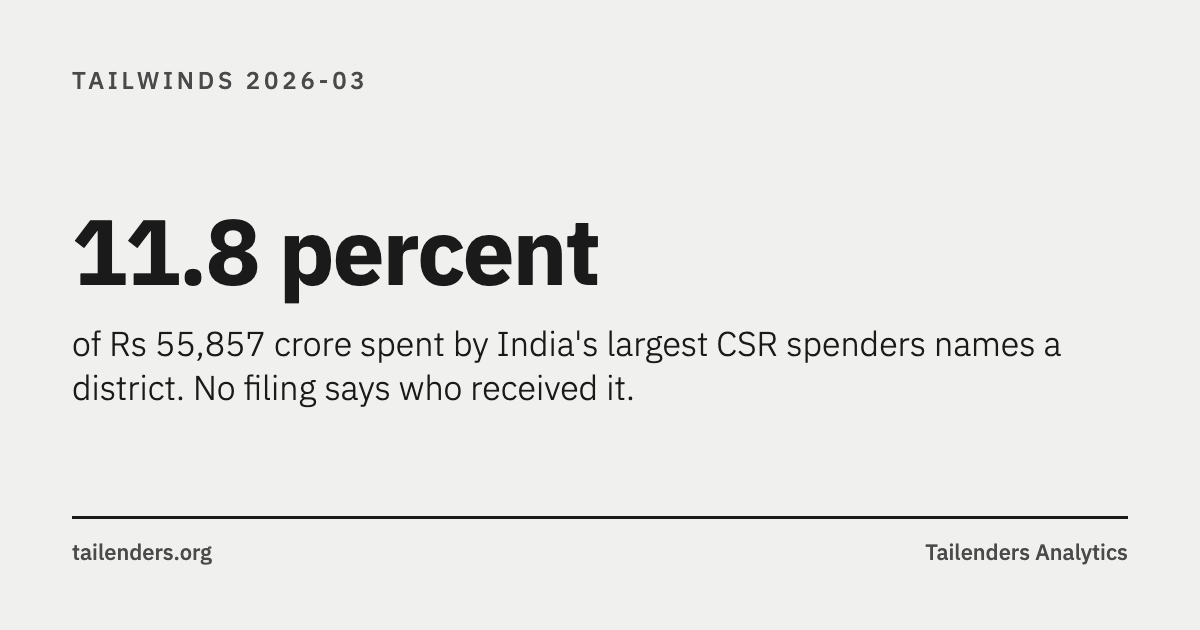
India requires its largest companies to spend 2 percent of their profits on corporate social responsibility. Their own filings rarely say where the money went, and none says who received it.
- 11.8 percent of Rs 55,857 crore (US$8.25 billion) spent by India's 357 largest CSR spenders names a district
- 26 of 55 companies that record where fail a test of reach to the tail end
- No filing says who received the money
Read the paper · PDF · DOI 10.5281/zenodo.23307292 · Download graphic
2026-02 · The Talisman Test
India's governance succeeds at campaigns and digital rails and fails at routine tasks that need an official's judgement: the FIR, the land record, the clinic, the classroom.
- Seven propagation rules, each with a test on Indian data
- Gandhi's talisman as the standard for who should benefit
Read the paper · PDF · DOI 10.5281/zenodo.23117021 · Download graphic
2026-01 · Tailwinds: how governance and grievance change moves across India
Right-to-services laws spread across Indian states as a front; natural farming spread as a wave, carried by farmers and self-help groups; UPI began as a wave and finished as a front.
- Interactive maps of how reforms crossed state lines
- A method for forecasting where a reform arrives next
Read the paper · PDF · DOI 10.5281/zenodo.23005367 · Download graphic
Data pages
Numbers from Pesticide Central
- India's drinking-water standard, its bottled-water regulation and the Jal Jeevan Mission's testing framework contain no limit for PFAS, the 'forever chemicals'; the Central Pollution Control Board told the National Green Tribunal in 2024 that 'there is no standard prescribed for PFAS in drinking water'. Source page
- 25,770 people in India died by suicide by consuming insecticides in 2023, 15.0 percent of all suicides (National Crime Records Bureau). Source page
- 31 places where pesticides were measured or reported in India's rivers, lakes and groundwater; 17 exceed India's own drinking-water limit for at least one compound. Source page
- 3.73 million tonnes of pesticide active ingredient were used worldwide in 2023 (FAO). Source page
- 3.42 billion people live in 10 km cells where farmland is at high risk of pesticide pollution (Tang et al. 2021, with our population overlay). Source page
Using our work
Quote it, republish it, tell us if we got it wrong
Papers, pages and graphics are licensed CC BY 4.0: quote, republish and adapt with credit to Tailenders Analytics and a link to the source. Questions about a figure, or an error you have found: write to hello@tailenders.org; corrections are made openly and dated.